11.6.26
Dear Matriarch Melody and her Mitchell Minions,
Right now I am writing to you from a bench beside the Rio Segura, the river that runs through the city of Orihuela. It is a beautiful and crisp Sunday afternoon, and the Mitchell family is probably just waking up in Meridian, Idaho.
It was on this very bench where three weeks ago my American friend Ben and I found two elderly Spanish buskers playing traditional Spanish music, one with a nylon-string acoustic guitar plugged into a small, scratchy amplifier and the other with a springy lute. The lutist sang in a gravelly voice that matched the scratchiness of his co-performer’s amp. I’ve learned that the majority of Spaniards start smoking cigarettes between the ages of 10 and 13, so their vocal chords have a rugged quality not seen in the United States. It makes everyday conversation just that much harder to follow but the richness in their singing voices, I’d say, nearly justifies the country’s high incidence of laryngeal cancer (one of the highest in the world, according to an article published by the Universitat de Barcelona).
Everyone sings here. And everyone sings well. Men walking down the street will burst into random operatic fervor, with strength and depth, in languages that sound like Spanish but I can’t understand. Last week two of my high school students bargained with me to let them (I thought) ‘play’ a song if they completed their assignment quickly and I said yes. I had apparently misunderstood the word, since after they finished, they belted out, at full volume, a dramatic love song from which I can paraphrase one lyric: “Que voy a hacer / Ahora que me has dejado.” My shock was two-fold when I realized they were not asking to play a song from their phone, they wanted me to hear it straight from their mouths, then again when the young student’s talent floored me. Especially so since he was quite a lazy and disruptive teenager from whom I expected little. If Ratatouille were remade in Spain, I’d think Chef Gousteau’s refrain might be rewritten to say, “Anyone can sing,” since that seems to be the norm in this country. And… because (sorry, Spain) the food in Orihuela has not led me to believe anyone can cook. But that’s for another letter.
Let’s return to our bench. My friend Ben and I stood watching the two elderly men play their instruments and sing in their scratchy baritones while another bystander explained to us what a lute was. Later that night, Ben ordered one online. Apparently the men play on this bench every Thursday at sunset, and usually draw a crowd of one and maybe a dog––to be honest, they weren’t very good musicians. But here, as I said, anyone can sing, and the lutist did so passionately. The guitarist did his best to follow the musical meanderings of his partner, who seemed to play whatever chord he wanted when he felt it, and after each song, the guitarist would look at me and Ben and shrug––the universal way to say, “I have no idea what this guy is doing.” We applauded anyways and meant it.
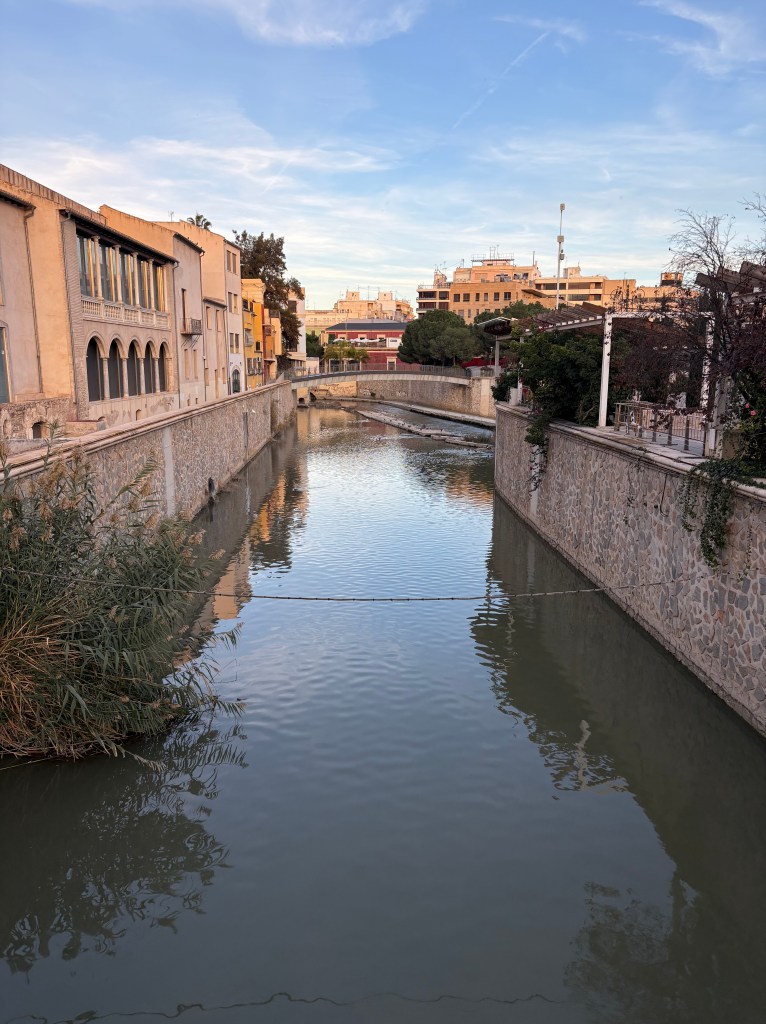
Ben and I continued our walk along the Rio Segura, trying to engage strangers in conversation to practice our Spanish, which is difficult considering their larynxes are made of sandpaper and they love to use curse words. So, Jasper, here’s a bit I can tell you about the Spanish attitude that’s different from America, and Jaden, I’ll try to give you a few good bad words and a few bad good words.
Firstly, Spaniards are far more aggressive in their speech than Americans. In Orihuela, it’s rare to see a smile across someone’s face when you say hello––no. It’s all business and there is no such thing as small talk here. When you walk into a restaurant, the first thing anyone says, before hola, before como estas, is dime––”tell me.” Tell me. What do you want. Why are you here. Let’s get this thing moving. My roommate told me about the time he visited America and was surprised that upon entering every restaurant, the waiter would do a whole song and dance: “Hi! My name is so-and-so, I’ll be your server, how’s everyone doing today? Can I get anything started for the table? Are we celebrating anything special today?” He complained to me, “Jeez, do they have to give their entire life story every time I just want a coffee? Let’s get on with it!” In a Spanish restaurant, there are no more than two words spoken by the waiter throughout your entire meal. The aforementioned dime, and then adios after you’ve eaten. That’s not to say the Spaniards aren’t friendly, but one can’t expect the typical signs from them that we Americans associate with friendliness. There are no smiles, no firm handshakes (always limp), and no friendly tones in speech. Instead, Spaniards make up for it with an eagerness to help and an everlasting patience, even if I am holding up the line of ten people at the post-office because I can’t figure out how to work the kiosk. No one’s rushing you, and no one is rushed. In America, holding up any line is enough to invoke the second amendment––luckily they don’t have that here.
Secondly, Spaniards love their curse words and they use them whenever they want, even in professional settings. I’m not going to repeat any here, lest you start a ruckus when you go to Boise’s Basque cultural fair. If you’d like an uncensored and comprehensive list of all the Spanish curse words I’ve learned, you’ll have to convince your mother and write me back with a signed permission slip. I digress. So, last week in class I asked a student, “Do you know what this word means?” and he responded, “no tengo ni &$#% idea,” the equivalent in english being something like, “I have no &$%#-ing idea.” My co-teacher, instead of reprimanding him, turned to me laughing and said, “Have you heard this word before, Luke? It’s a curse word we like to use a lot here.” Later on I began picking up that and other words in the teacher’s breakroom––all of them using curse words in front of, behind, and about their students like it was no big deal.
That being said, there are many nice, common phrases that I am willing to tell you here, the most common being the words vale and venga. Every other word here is vale or venga. It’s like saying “okay” or “alright.” Vale literally translates in english as value, and venga means “come.” But to say something like “alright then,” or “sounds good,” you’d say vale venga. And if you want to be friendly, just add tio to the end of it, meaning “uncle.” But here it’s like saying “thanks, man,” or “sounds good, bro.” But my favorite word I’ve picked up so far is the affectionately mischievous gillipolla (pronounced hilly-poya). My students are constantly calling each other gillipolla which I’ve taken to mean something like “dum-dum” or “idiot.” I just love how goofy it sounds and how it borders the line between a friendly jab and cursing insult. I still wouldn’t suggest pulling this one out at the Basque fair, but you might get away with it on the playground with your friends.
So, I hope I’ve answered a few of your questions, and if you have more, write me back! In the spring I hope to visit the Basque country in the north and then maybe in America next summer I can visit the Basque festival with the Mitchells! Until then, hold down the fort!
Best, Luke
 swellpunk.com