12.2.25
Dear Jonathan,
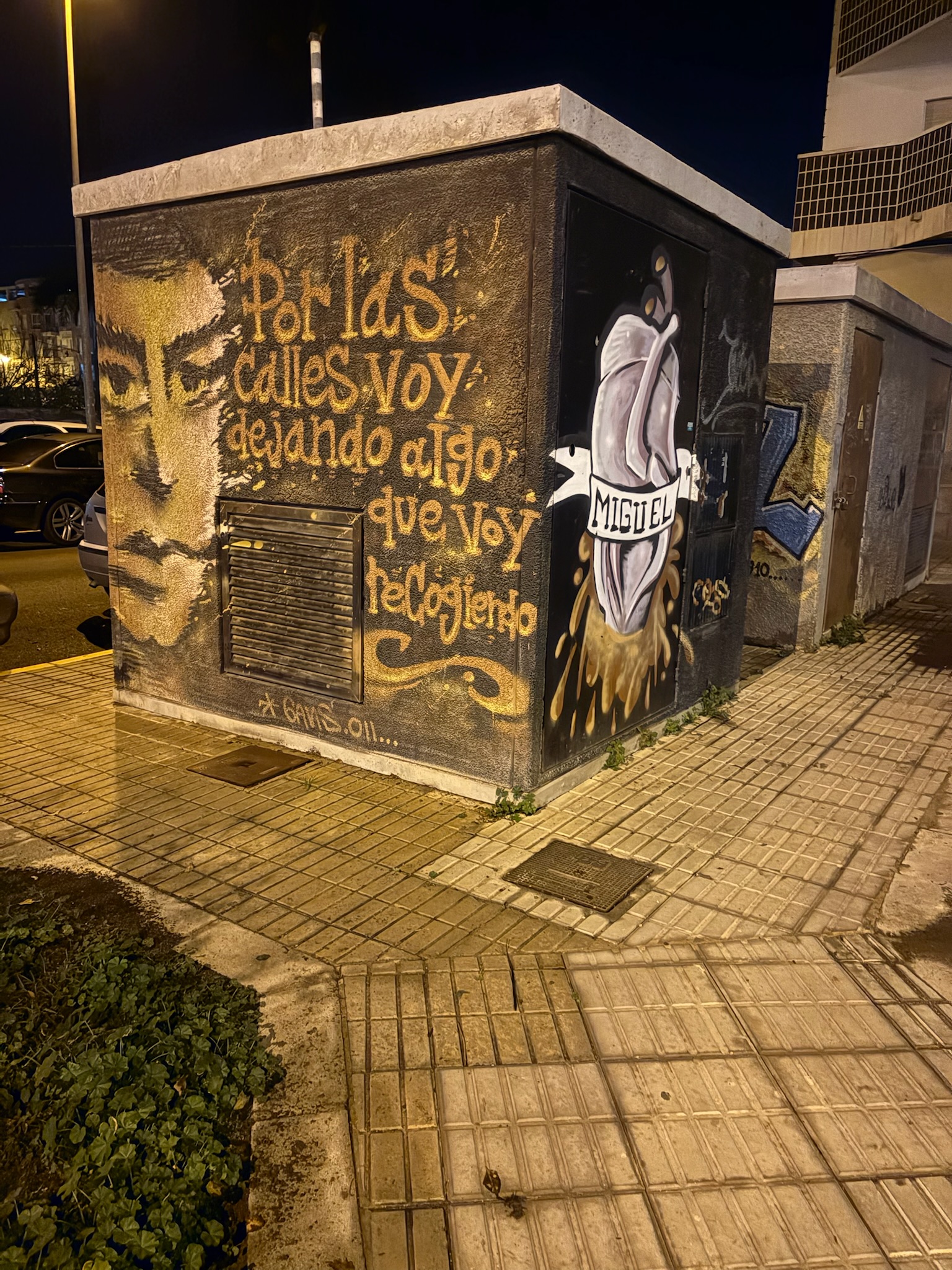
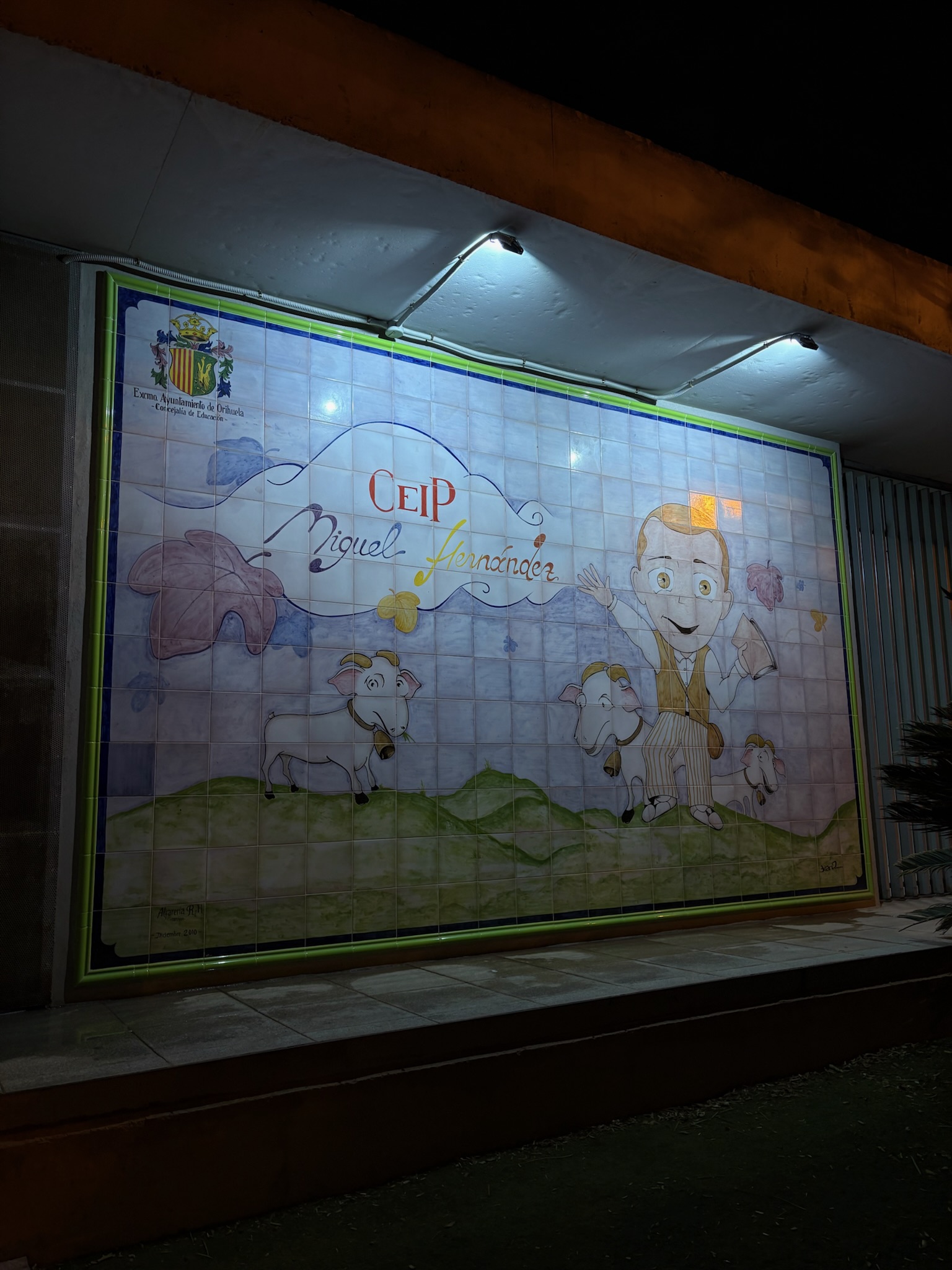
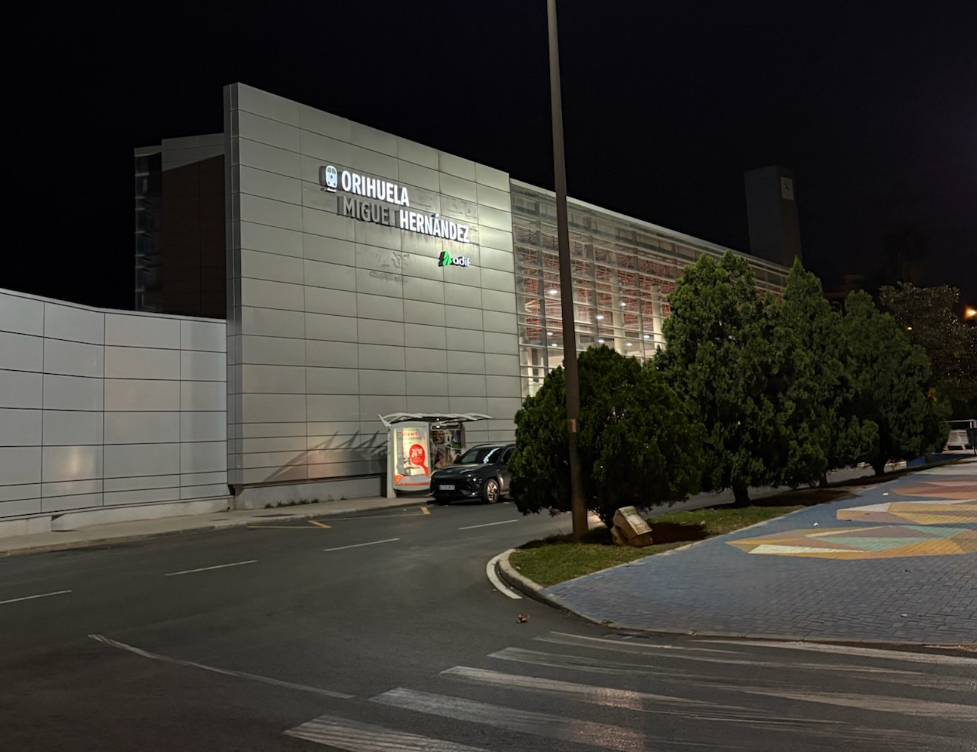
Five minutes from my apartment is a train station called Orihuela-Miguel Hernandez, named so for the city I live in, Orihuela (whose etymology likely relates to the spanish oro for gold) and Miguel Hernandez Gilabert, a legendary Spanish poet, soldier, political activist, and martyr born in Orihuela and active in the 1930s during the Spanish Civil War. In Orihuela, there is a school, a cafe, a plaza, a park, a university, and a museum named after him. Even more, thirty minutes away is an international airport called Aeropuerto Alicante-Elche Miguel Hernandez, so named for the two cities it sits between and again, our poet-warrior. He’s ubiquitous.
Miguel Hernandez’s name pops up daily on my walks around the city, and from the first week it was clear his mythological presence was essential to the history of the city. I went to the local library and found stacks and stacks of his poetry, anthologies and their commentaries, but it wasn’t until a friend of mine working at another school nearby brought home a short biography about Orihuela’s crown prince of literature that I got to know who he was.
Miguel Hernandez Gilabert was born in Orihuela, 1910 to an impoverished family of goat farmers in the rural fields of the Vega Baja. (The very same fields and dirt paths I ride my bike across to get to school every morning; they smell heavily of alfalfa and artichokes––it’s no citrus orchard to the nose but I’ve grown accustomed to the earthy-sweet smell.)
Miguel carried with him a small notebook and pen while he herded livestock for his father, spending the majority of his youth outdoors, in nature, in solitude, and in want. His family could hardly afford to feed themselves so as a young man, Miguel let his passion for poetry and literature propel him to Madrid where he worked for local magazines and newspapers as a contributor, all the while borrowing money from friends, couch-surfing, and soliciting patrons to sponsor his poetry. Miguel managed to secure a sponsorship from an Orihuelan family friend and lawyer named Ramon Sije, who funded Miguel’s works through his literary magazine. The two were inseparable friends, both with passions for literature, though differing greatly in political views. At age twenty-seven Miguel joined the Spanish civil war as a member of the Spanish Communist party, fighting as a Republican against Franco’s fascism. With the Republican’s surrender Hernandez attempted to flee but was caught at the border of France and was sentenced to the death penalty. Later, his sentence was mitigated to life imprisonment and he died incarcerated at age 32 from tuberculosis.
Hernandez wrote swaths of poetry in prison, much of it motivated by his socialist sympathies, his wife and young children, and past loves he was still simping for. The book that I learned all of this information from, however, was half-biography and half-anthology of only his early works, which mostly dealt with his youth as a goatherder––themes of nature, love for animals, and a deep self-reflection permeate what I read. Here is one of my favorites:
Lagarto, mosca, grillo…
Lagarto, mosca, grillo, reptil, sapo, asquerosos
Seres, para mi alma sois hermanos.
Porque Iris senala
con su regio pincel
vuestra sonora ala
y vuestra agreste piel.
Porque, por vuestra boca venenosa y satanica,
fluyen notas habidas en la siringa panica.
Y porque todo es armonia y belleza
en la naturaleza.
Lizard, moth, cricket…
Lizard, moth cricket, reptile, toad, disgusting
beings, in my soul we are kin.
Because Iris sings
with her royal brush
your resounding wings
and your skin, tough.
Because, from your satanic and venomous snoot
flow notes found in Pan’s flute.
And because all is beautiful and harmonious
in wilderness.
Miguel Hernandez undoubtedly is a beloved figure in Orihuela, but also in the whole of Spain. In the larger Metropolitan area of Alicante a few weeks ago I met a woman who, upon hearing where I lived, instantly burst into praises for Miguel Hernandez, literally calling him “the voice of Spain.” A local theater recently played a musical a spanish playwright had written about him. The city library currently has an art installation up, with sculptures and paintings exclusively inspired by Hernandez’ poetry. I think about poets in America, and besides some dudes who lived hundreds or a hundred years ago, I could hardly name a single one. Let alone compare them to the magnitude of influence this poet continues to have on his country and his hometown. I feel honored to live where he lived, to walk among the fields and pastures that he worked and smell that same stinking alcachofa.
Sincerely,
Luke
PS: Some honorable mentions of art I’ve seen/consumed while here––Ernest Hemingway’s the Sun Also Rises was a depressingly apt description of Americans wandering in Europe (especially Spain) in the hopes of finding themselves.
I see two men busking beside the river by my apartment, one on the lute and one on the guitar. Both having smoked their whole lives their voices resonate with a deep richness only throat cancer can provide.
In Madrid my friend and I were wandering a distant alleyway when a very old woman stopped us and said, “Look at that,” and pointed to the balconies of an apartment building where pairs of blue jeans were hanging on clotheswires, except the pants were sewn shut at the ankle holes and the legs were stuffed with soil and grass was growing up out of the waists. About twenty pairs lining the entire block of the building. Then below that, massive street art covering garage doors, graffiti, tagging, and murals. One section of this wall was lined with pastel-painted 2-liter soda bottles, an entire wall full. I asked the spanish woman, “What is that?” And she replied, “I don’t know but it’s nice to still have art in this neighborhood.” Then she leaned in closer to me and said, I’ve lived in this neighborhood my entire life. Soy gata. I’m a real Madridena.” It made me curious if the word for cat was also a colloquial way to identify oneself as an authentic Madridian, and not a transplant, which she seemed keen to emphasize. Before I could ask what she meant she had hobbled away and my friend and I stayed to admire the wall of plastic bottles, hundreds of them strung on lines like the jeans and hanging against a brick background. I wonder what made that woman stop to talk to us, two obviously American tourists, the kind of people that people who call themselves “real madridenas” I imagine would hate. Most people on that trip spoke english to us, not her. She went straight to Spanish and didn’t stop to check if I understood. I felt honored to be able to.
 swellpunk.com