12.12.25
Dear Josh,
Outside the post office I read a piece of paper someone tacked onto a streetlamp. It writes: se ofrece chica para cuidado de mayores y niños o limpieza de casa with her phone number. Instinctively I translate it as girl offers herself which in one sense is true, and in another sense is probably less true. A typical American equivalent might read: Looking for work, but never would we offer ourselves so completely.There’s a lot of graffiti in this town, most of which I can’t understand except for one near the Police Station––a pro-Nazi tag that reads “Skins ⊕ Murcia” which is covered by another tag reading “Fuck Nazis, en mi barrio nada es ario”. In my neighborhood, no one is aryan. Whether this has anything to do with the police or not I have no idea, the location could be coincidental.
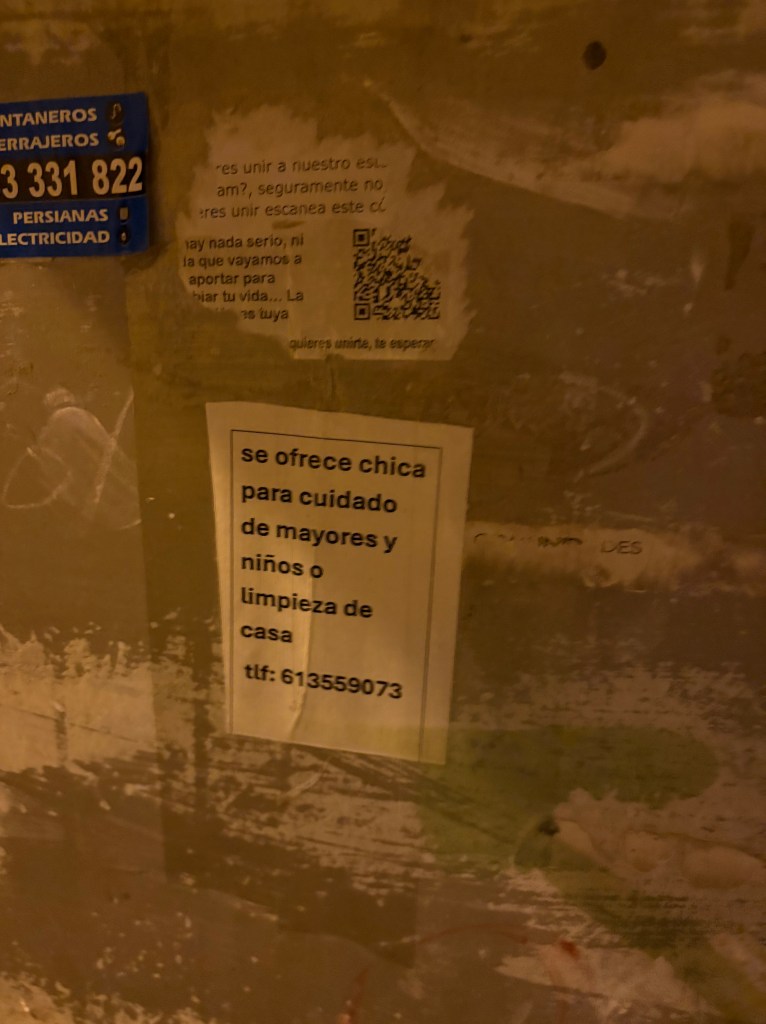

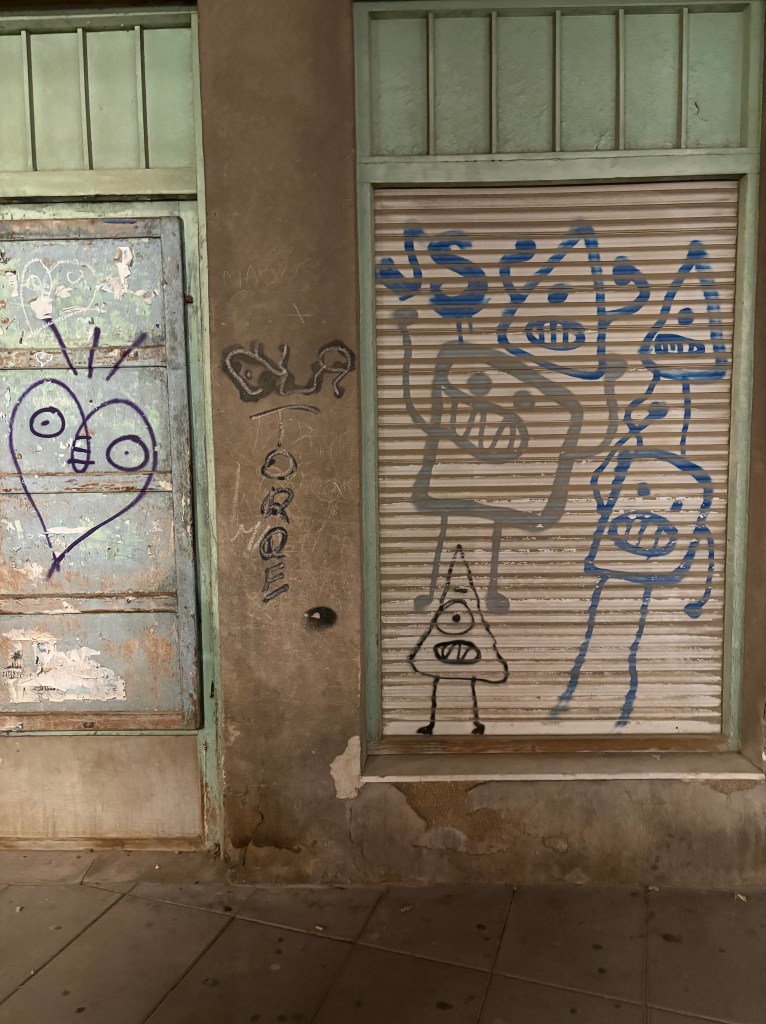
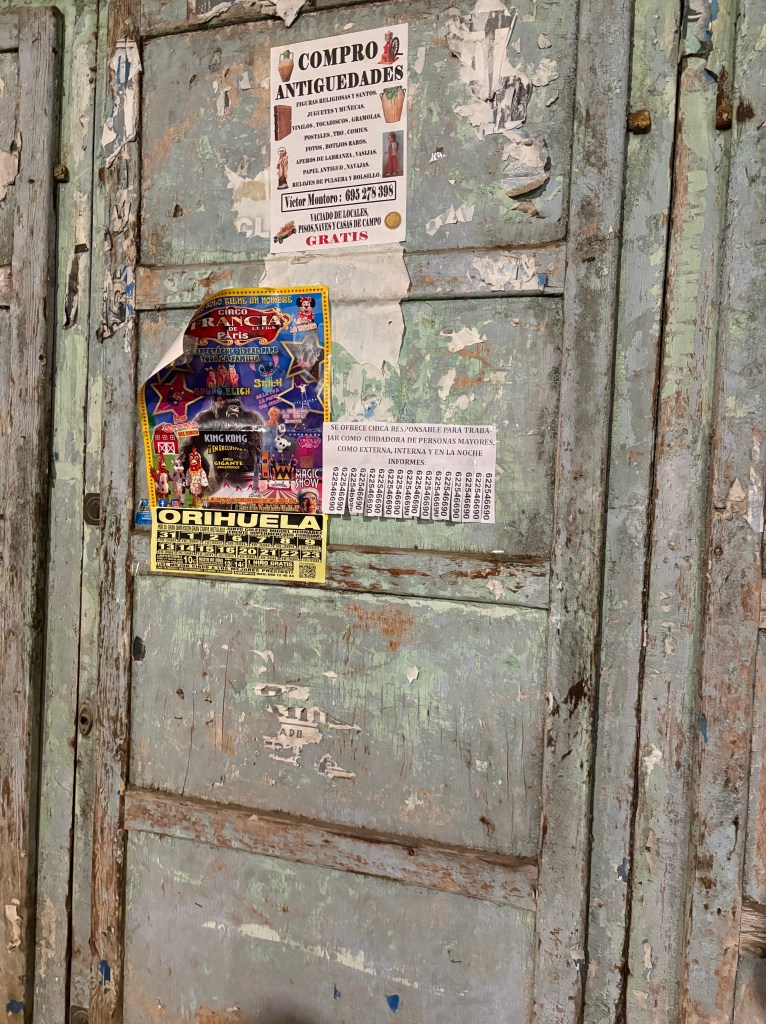
Ever since you asked this question, I’ve noticed that Spaniards really aren’t big on signage. Any event promotion signage is without fail from a DJ doing a set at a club, usually in Torrevieja or Orihuela Costa, Orihuela’s sister cities on the coast.
In the classrooms I frequent, there will be maybe one poster and it will usually have an AI-generated Jesus on it, with a 21st-century-looking student beside him. The walls of my school are bare, and sad. Last week I saw a poster advertising a school soccer match, the younger grades versus the older grades, but the posters are gone now. I don’t know how Spaniards discover the happenings of their town. There are a lot of happenings that pop up, seemingly to me, randomly––a marching band, a halloween block party, a christmas market and tree lighting, a farmer’s market. These events and the crowds that attend them come out of nowhere and disappear just as quickly. One morning I stepped outside my front door and there was a 5k against domestic violence happening. My entire street was closed. Someone’s not telling me something.
There are a few small bookstores in this town, all single-rooms with limited selections, but there is an abundance of antique stores selling tossed-out paperbacks that few would want. The public library is currently hounding me because I borrowed some english textbooks to use in private lessons, and I wish I could explain to them that I’ll give them back before I go home in May, but I’m gonna keep them until then.
There’s a plaza near my apartment called the Glorieta. Maybe half the size of a football field, it’s an open, marble-tiled space in the center of town where friends meet, kids play pick-up soccer, and weekend markets take place. I go there sometimes four or five nights a week and sit on one of the ten benches that line the periphery. There’s a speaker system that plays classical music quietly among the trees, and sometimes there’s an eccentric young man who wears gigantic pants, floppy shoes, bandanas, multiple coats, and forearms full of bracelets. He carries on an over-the-shoulder strap a large boombox and walks in circles around the block, returning every 10 or so minutes to the Glorieta. Sometimes there is music playing from the boombox, like Pitbull or something you’d hear in a dance club, but other times there are podcasts or radio shows playing and spanish hosts are spewing some type of political message I don’t fully understand the context of even if I can make out the words. He walks with a swagger––a jaunt––and wears dark sunglasses even though it’s night when I see him. He looks like the type that in America would be on some amphetamines, but there is a cohesion to his presentation that doesn’t concern me, and amphetamines are rare here. It’s actually been a few weeks since I’ve seen him, though I used to see him multiple times a week. Other than that, there are two old men who busk by the river on Thursday nights and allegedly have been doing so for years. And that’s the music people listen to on street corners in Orihuela. In Madrid, the buskers were numerous and very talented. Spanish people smoke, so their voice boxes are tinged with a rich, tragic, sentiment. Musicians will often sing to express their pain––I think Spaniards sing and it is pain.
Luke
 swellpunk.com